SOCIAL DISRUPTIONS week II, 24-04 by Enzy Jhang
SOCIAL DISRUPTIONS week 2, Enzy Jhang.
dd. 23/04/2026 by Enzy Jhang
Before I share the update about my second week of residency at SIGN, I do have to start with my personal story that led me to the current project.
I worked in a warehouse until two weeks before the residency started. At this warehouse, I experienced the most intense work situation in my life. I had the most lovely coworkers in one hand and the most evil CEO on the other. Even the most cliché movie would not make the plot this obvious. The CEO was ignorant and stupid to say the least. He didn’t know the legal liability and responsibility for operating the warehouse. The warehouse was not cleaned for 45 years, no one knew where our official fire emergency exits were, and fire hoses were blocked with stocks and boxes. If this wasn’t enough already, on my last day of work, broken asbestos was found on the floor (which was later found to be the leftover from an uncertified company trying to remove the asbestos) by one of the staff, and we all had to evacuate after working there for 1 hour. I still don’t know how this place is running or managing to hide these events from the media, but I had to do something about it. Something that can help me process my anger and channel it into something useful and not completely exhaust me.
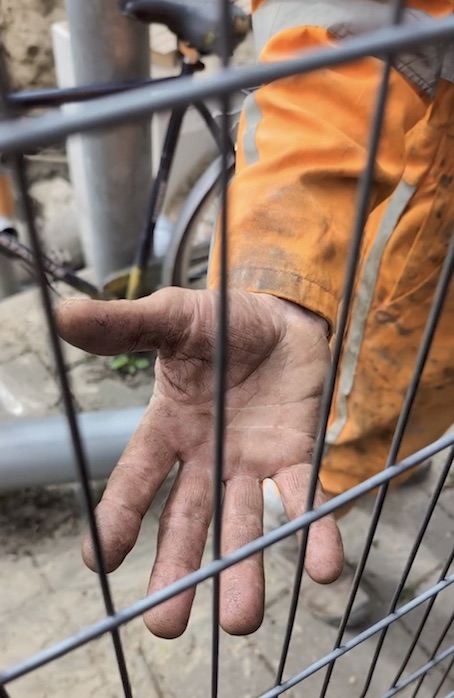
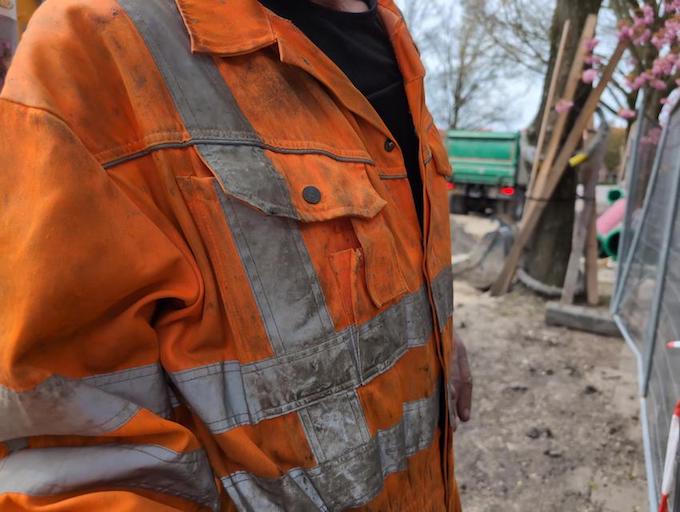
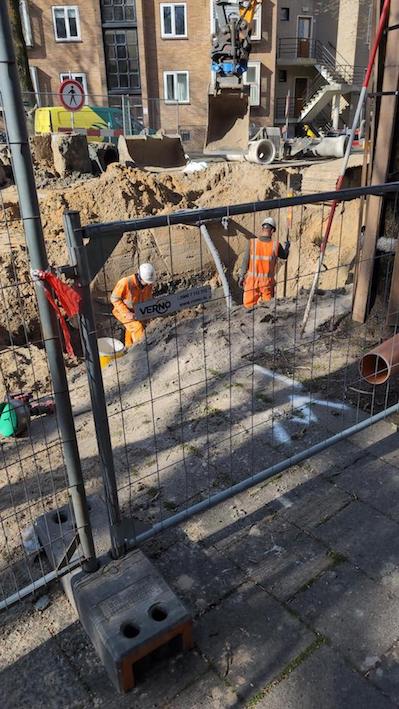
So when I saw the construction workers in front of the hotel I was staying at, working in a deep sand pit with an excavator fork hanging right next to their heads, the images of my coworkers overlapped with them. I wanted to make a work dedicated to them. About the people who are the concrete foundation of our immaterial, intangible industry, and yet only a few care about.
The first time I met them was quite awkward, as any first encounter is. But soon after, I noticed that they are also waiting a lot of times during their work and are up for a chat with the neighborhood people. Due to my very limited Dutch skills, I had to ask SIGN’s great helper, Siem, to join me to talk to them on my first official talk with everybody. I was so nervous that I had a stomachache for three days before the meeting. But the talk went surprisingly well. The workers really understood where the root of this project was coming from. It was quite a strange and thrilling feeling of solidarity I found in a city where I had just arrived.
After the first meeting, I found out that almost all of them are from Friesland traveling to Groningen, as there are not enough construction workers in Groningen to cover all the work happening in the city. So I went back again on my own with some Groningen’s Koek and Friesland’s suikkerbrood. They were excited about my breads (especially the suikkerbrood), so I used this moment to directly ask if anyone was interested in joining my project. An older guy who definitely looked like the most experienced construction worker on the team said he is interested. And two other men who are working closely with him also said they are thinking about it. So my bribe tactic worked.
Since then, everyday I would get up and start my routine by greeting all the construction workers, I’d ask how they are doing, if the work is going well, and they would tell me “he has 7 Frisian horses”, “this guy has 7 kids and lives in Leeuwarden”, “This guy always stands on top of the construction site so he can chat with everyone all day and work less!” etc. Then I would tell them that I live in Amsterdam, have been living in the Netherlands for 5 years now, and that I came here to study, and that I can proudly say “Goed Bezig!” to them.
When I would have these conversations with them over the construction fences, I looked at their working clothes, their rough hands, and the safety shoes they were wearing. And then wonder, despite all the technological “advances” that so many people talk about, there are no devices to prevent them from getting injured by moving concrete pipes, relocating cables in a deep sand pit next to huge excavator claws, and cutting plastic pipes with a chainsaw. What an irony!
I wonder for whom this technological “development” happens. Who facilitates it with their finances, and who gets to control the technology and decide the distribution methods? Whoever that is, they are not doing it for the construction workers nor for us. Then how can I work with the construction workers and not neglect their needs? How can I protect them safely during the project? How can I not repeat the industry’s mannerisms and give them what they deserve with their physical labor?
I will not prematurely decide the answers here. The time I spend with the workers will lead the way. And when the intervention happens, you will see my version of answers coming from stubborn hope for the workers and the trust in people.